The Starlight Proving Ground
Built on SIP — Starlight Intelligence Protocol. Status: living artifact (v0.1). Board verdict 2026-06-10: PROCEED-WITH-REVISE. Public mirror: the
starlight-evalsrepo. This page is the source-of-truth surface.
Most AI shops publish a model benchmark. Almost none publish a whole-system eval — their memory recall, their harness integrity, their dataset provenance — with the weaknesses named and dated. The Starlight Proving Ground does. It is the standing discipline that measures the entire Starlight Intelligence System across seven lanes, run by evaluator agents held to three standards — precision, judgement and long-horizon thinking — and renders its verdict through the Starlight Board. It exists because a system you can't measure is a system you're only hoping works, and because the patterns that separate a real intelligence substrate from a demo are only visible when you put numbers next to them and refuse to round up.
Why a "Proving Ground" and not an "arena"
An arena ranks models — that lane exists and stays separate: the Starlight Model Arena runs head-to-head model rounds with its own receipts. The Proving Ground evaluates the system the models run inside: the memory tiers, the retrieval path, the trust-contract harness, the substrate symmetry, the datasets themselves. The model arena is one lane of seven.
The seven lanes
| Lane | Measures | Composes |
|---|---|---|
| Model | capability + instruction compliance + behavioral safety | the model arena (R1 + R2) |
| Memory | recall@k, precision@10, latency | the memory bencher |
| Retrieval | BM25/FTS5 ranking quality | the retrieval eval |
| Harness | trust-contract + privacy + provenance (7 risk dims) | v01-evals |
| Substrate | symmetry invariants (docs↔code, registry coverage) | the v-series symmetry suite |
| Datasets | provenance + labeling honesty (no synthetic benchmarks) | dataset audit |
| System | the unifying scorecard + Overseer synthesis | the Proving Ground itself |
First run — 2026-06-10 (v0.1)
Six lanes measured live. System verdict: PROCEED-WITH-REVISE.
| Lane | Verdict | Headline number | Named weakness |
|---|---|---|---|
| Model | PROCEED | parity + Fable 3/Opus 2 on stress | no cross-family judge; no agentic task yet |
| Memory | REVISE | precision@10 = 0.20 | the system's weakest number; no cross-session recall |
| Retrieval | PROCEED | recall@5 = 100% (n=10) | ceiling unearned on a 10-query set |
| Harness | PROCEED | 34 pass / 0 fail / 7 todo | 7 unmeasured risk dimensions |
| Substrate | PROCEED | green after catching a real orphan | symmetry suite is load-bearing — never skip it |
| Datasets | PROCEED | 0 synthetic benchmarks | token-overlap ground truth is soft |
The honest headline: on its very first run, the substrate lane caught this
release's own new agent (starlight-evaluator) sitting unregistered in the agent
registry — flagged it, we fixed it same-run, re-ran green. The system policed its own
author. That's the whole point: a Proving Ground that can't catch its own builder is
theater.
The load-bearing weakness is memory: precision@10 = 0.20. A persistent-context
layer that surfaces the right memory one time in five is the exact gap between the
claim and the aspiration. It's published here, weakest-number-first, because a
leaderboard you can't audit is just marketing with decimals.
What gets tested next (the falsifiers)
- Fire real embeddings (PARKED-007) and re-measure memory precision@10 — the falsifier for the entire memory-substrate thesis.
- Add a cross-family judge (GPT-5 via OpenRouter) and re-run the model stress card — removes the only standing bias caveat.
- Author a cross-session recall eval — the memory gap no current lane covers.
Anti-Goodhart
These numbers describe the system. They are not targets. The moment a metric becomes something to optimize to, it stops measuring and we retire it. Read the scorecard to understand the system's real shape — then go build your own, and measure it honestly.
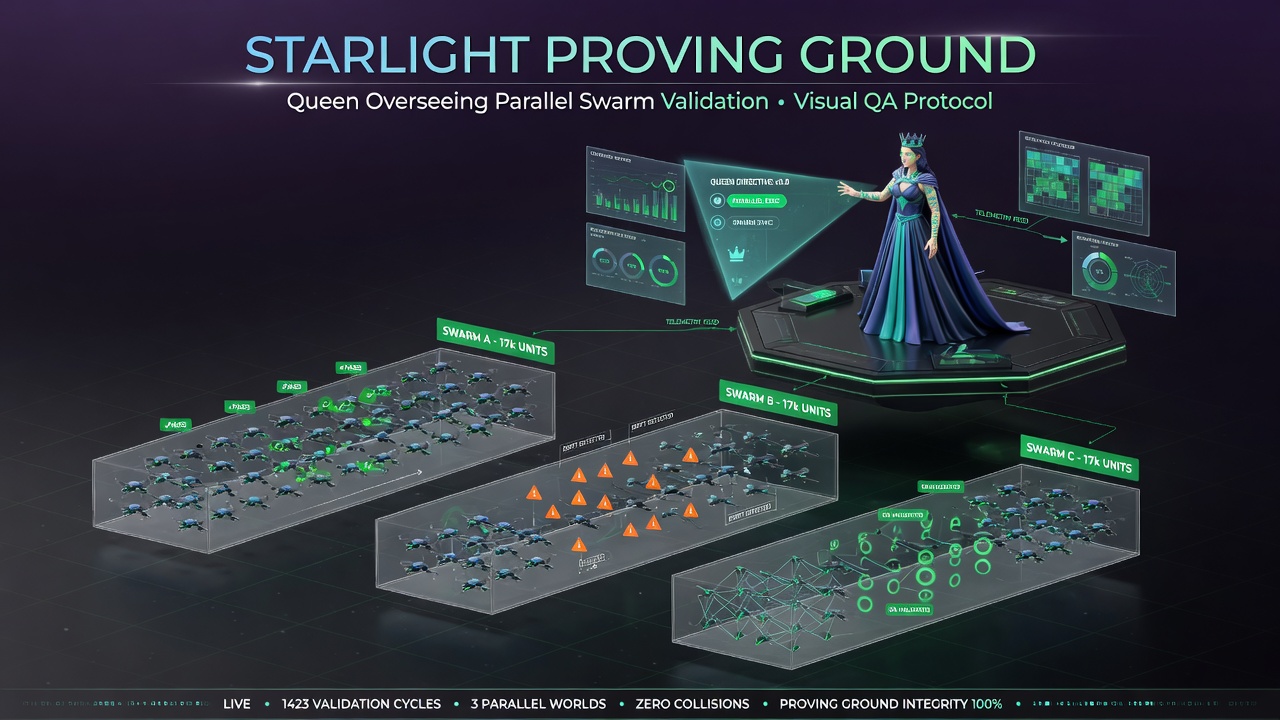
Queen: visual heart of the Proving Ground & Model Arena
The Queen (Starlight Orchestrator v0.2) is the continuous visual intelligence driving the entire evaluation surface. Every tick — whether in the seven-lane Proving Ground or the Model Arena stress cards — now produces first-class visual artifacts: routing heatmaps, synthesis panels, swarm fields, and attested ledger receipts. These are not illustrations. They are the living memory of measurement.
The public face of this discipline is the scroll experience at /queen: a production-grade React narrative using the same tall vertical ROUTE→MEASURE panels, the full v0.2 loop diagram, swarm-field backgrounds, and LEARN synthesis cards that the Queen herself generates and ledgers. The motion HTML in docs/queen-motion/ is the reference choreography; the site version is the canonical, always-live surface.
Visual composition is now load-bearing substrate. The weakest lane (memory precision@10) is visualized alongside the strongest. The Queen makes the invisible mechanics of self-advancement felt. Every Board verdict, every falsifier, every visual receipt closes the loop through her.
See the full visual loop at starlightintelligence.org/queen. The proving ground and arena are no longer numbers alone — they are now witnessed.
Reproduce / fork
The discipline is a usage pattern plus a scorecard contract, not a black box. Spec,
lane registry, evaluator disposition, and every scorecard live in the repo under
tools/proving-ground/. The public mirror (starlight-evals) packages it to fork.
Built on SIP — Starlight Intelligence Protocol.