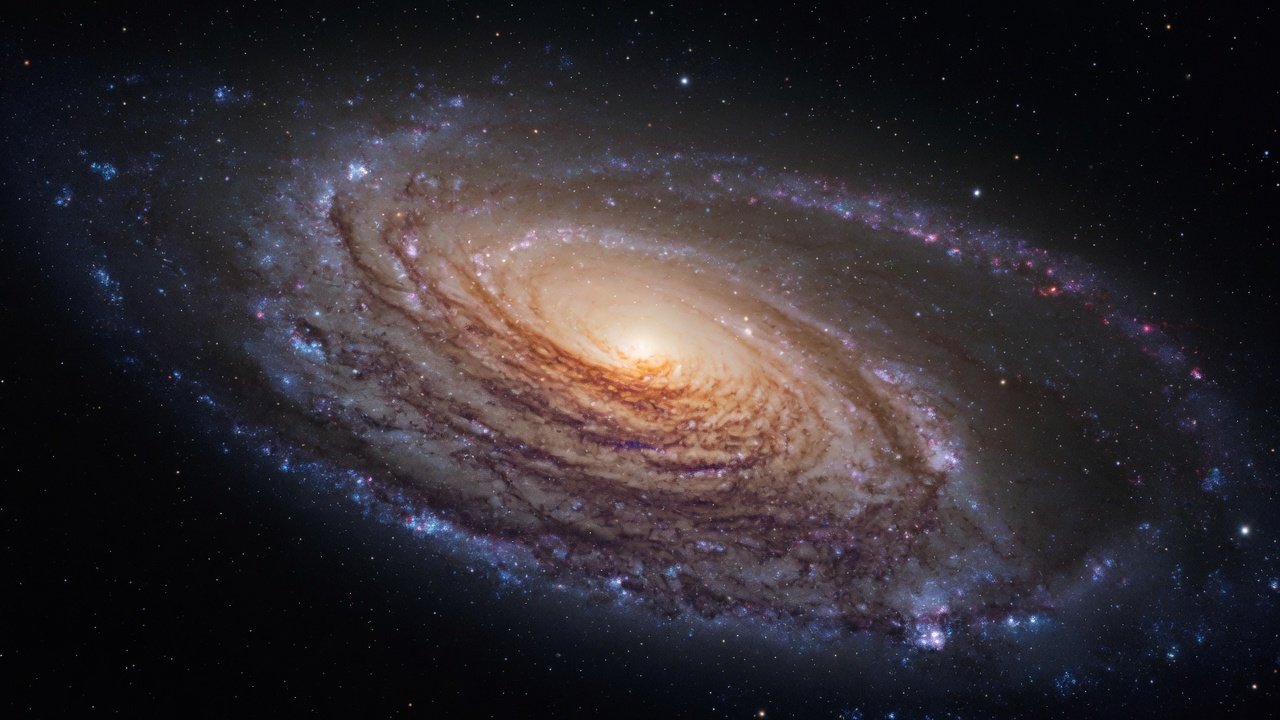
Proxima Centauri is the nearest star to the Sun — 4.246 light-years away — and you cannot see it. It is an M5.5Ve red dwarf carrying only about 12% of the Sun's mass, so dim that at eleventh magnitude it needs a telescope despite being closer than anything else that burns. The nearest star in the sky is invisible in it. That inversion — proximity without visibility — sets the tone: the most reachable star is one of the hardest to reckon with.
The faint third member
Proxima was only discovered in 1915, by Robert Innes, long after its bright neighbors. It belongs to the Alpha Centauri system: Alpha Centauri A and B are Sun-like stars orbiting each other closely, while Proxima circles the pair from roughly 13,000 astronomical units out — about a fifth of a light-year — on an orbit of roughly half a million years. Fully convective, it mixes its entire hydrogen supply into the core and burns it with extreme thrift. Red dwarfs like Proxima have projected lifespans in the trillions of years — hundreds of times the current age of the universe. Long after the Sun has died, the Proximas will still be burning — the last stars lit anywhere will look like this one.
Planets next door
In 2016, radial-velocity measurements confirmed Proxima b: a planet with a minimum mass of about 1.07 Earth masses, orbiting every 11.2 days at roughly 0.05 AU. Because Proxima is so faint, that tight orbit sits inside the habitable zone — the range where liquid water could exist on the surface. A second confirmed planet, Proxima d, is a sub-Earth (roughly a quarter of Earth's minimum mass) orbiting even closer, every five days. The nearest star has a rocky planet at a temperate distance. That fact reshaped both exoplanet science and interstellar ambitions.
The flare problem
Whether Proxima b is habitable is genuinely contested. Proxima is a violent flare star: it erupts frequently, sometimes brightening dramatically in minutes, and a planet at 0.05 AU takes the full blast. Over billions of years, flares and stellar wind may have stripped Proxima b's atmosphere and irradiated its surface; the planet is also likely tidally locked, one face in permanent day. That is the pessimistic case. The optimistic case: a thick atmosphere, a strong magnetic field, or a deep ocean could shield the surface, and atmospheric circulation can redistribute heat on locked planets. Both cases are consistent with current data. Nobody knows yet — the honest answer is that Proxima b is the best nearby laboratory for finding out.
What 4.25 light-years actually means
The distance sounds small until you price the propulsion. Voyager 1, the fastest object humanity has sent into interstellar space, moves at about 17 km/s; pointed at Proxima, it would need on the order of 75,000 years. Chemical rockets do not get meaningfully better. This is why Breakthrough Starshot proposes abandoning rockets entirely: gram-scale probes on light sails, pushed by a ground-based laser array to a target of 15-20% of light speed, arriving in roughly 20-30 years. Every part of the concept is a hard engineering problem — laser power in the tens of gigawatts, sail materials that survive the push, returning data across four light-years with milliwatts. But it is physics-legal, and Proxima is why it targets where it does.
Why it matters to a builder
Proxima is a lesson in observability: the most important node can be the one your instruments miss. The nearest star went undiscovered until 1915 because brightness, not distance, is what surveys select for — audit what your metrics privilege, because the critical dependency may be dim. The habitability debate models good reasoning under incomplete data: hold both hypotheses, state what evidence would discriminate, and resist premature conviction. And Starshot is constraint-driven design at its purest — when the standard architecture is five orders of magnitude short, you do not optimize it, you change what you send.