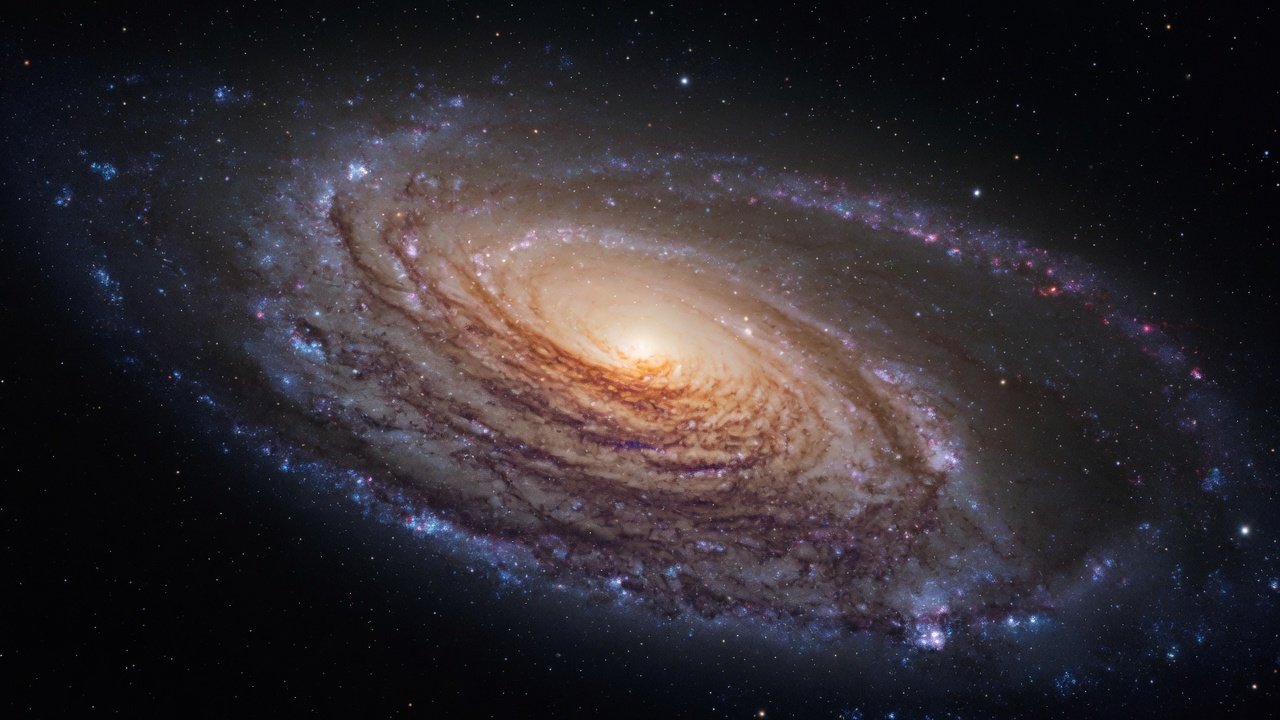
We have never touched a star, sampled one, or sent an instrument into one. Yet we know what stars are made of, how hot they are, how fast they move, and whether unseen planets tug at them. The entire inventory comes from one method: reading the light. Every element has a barcode, and starlight is a database we learned to query.
Dark lines in the rainbow
In 1814, Joseph von Fraunhofer passed sunlight through a fine prism and found the spectrum interrupted by hundreds of dark lines — fixed, repeatable, unexplained. The explanation took until 1859, when Gustav Kirchhoff and Robert Bunsen showed that each chemical element, heated in a flame, emits light at its own exact set of wavelengths — and absorbs at those same wavelengths when light passes through it cold. Fraunhofer's dark lines were absorption fingerprints: the Sun's atmosphere subtracting its composition from the light below.
The method's first triumph was finding something that wasn't supposed to exist. In 1868, observers of a solar eclipse recorded a yellow line matching no known element. It was named helium, after helios — discovered in the Sun 27 years before anyone isolated it on Earth. Chemistry done at a distance of 150 million kilometers.
The barcode also encodes motion
Spectral lines have exact rest wavelengths, which makes them speedometers. If a star moves toward you, its lines shift blueward; away, redward — the Doppler effect, the same physics that bends a siren's pitch.
This is how most early exoplanets were found. A planet orbiting a star pulls the star into a small counter-orbit, and the star's spectral lines wobble back and forth in rhythm. The radial-velocity method reads that wobble — meters per second of stellar motion, detected across light-years — and from it extracts the planet's period and a bound on its mass.
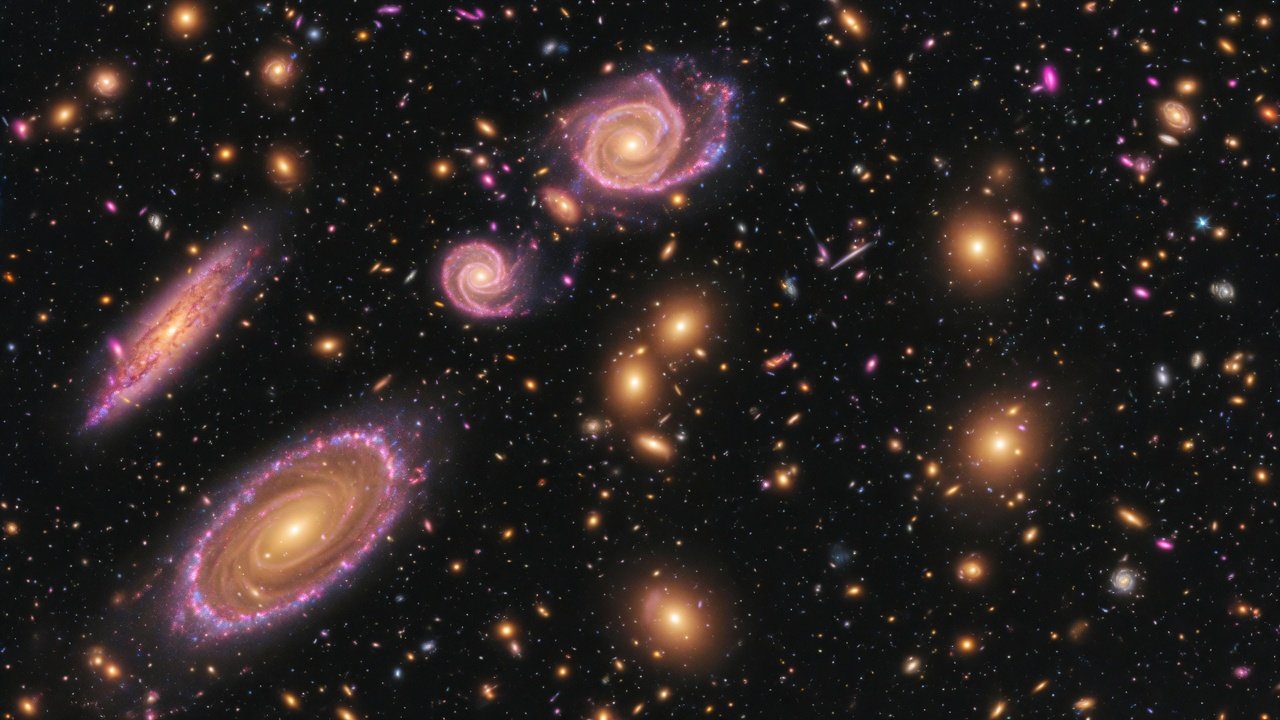
Scale the same trick up and you get cosmology. In the 1920s, Edwin Hubble and Georges Lemaître connected a pattern in galaxy spectra: nearly all of them are redshifted, and the farther the galaxy, the larger the shift. The Hubble–Lemaître law — recession velocity proportional to distance — is the observational backbone of the expanding universe and, run backward, of the Big Bang itself.
Why it matters to a builder
Spectroscopy is the canonical example of extracting structured data from a signal you cannot interact with — pure read-only observability, pushed to its limit. One instrument class yields composition, temperature, velocity, planetary companions, and the expansion of the universe. The engineering lesson: when you cannot instrument the system directly, invest everything in decoding the signal it already emits. And practically — before anyone mines an asteroid, its composition will have been read the same way, by spectra, from millions of kilometers away.