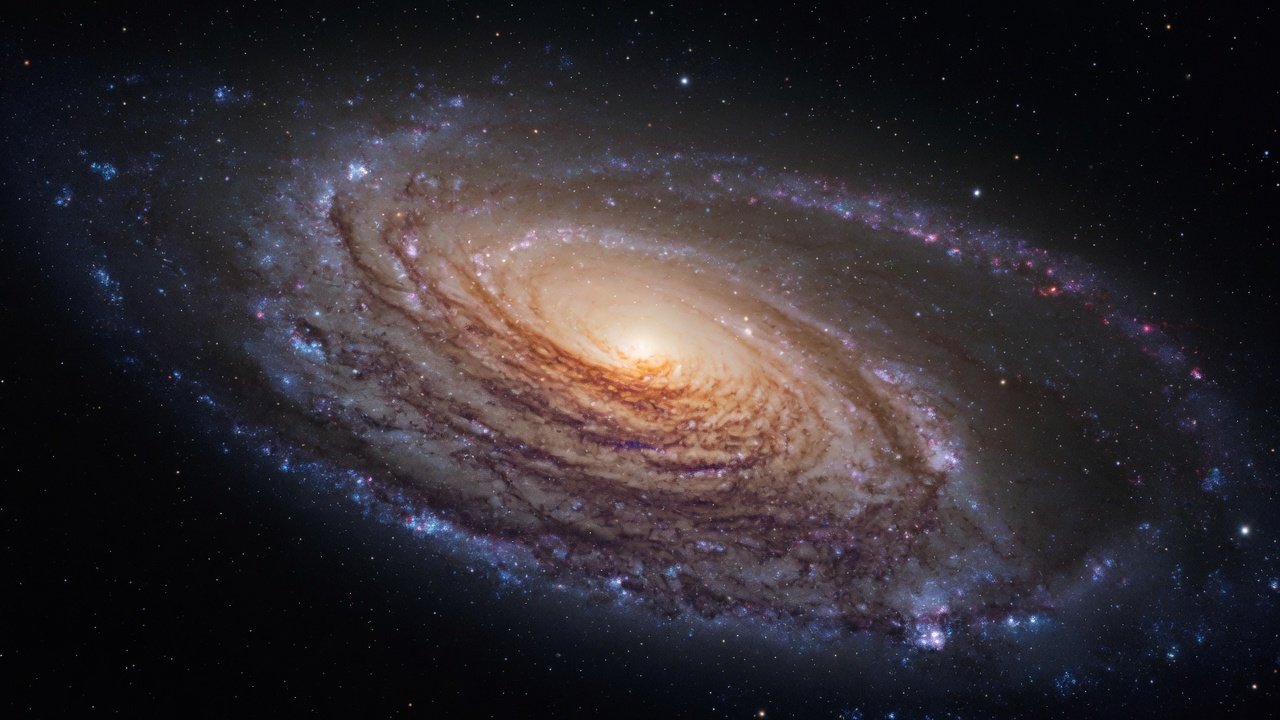
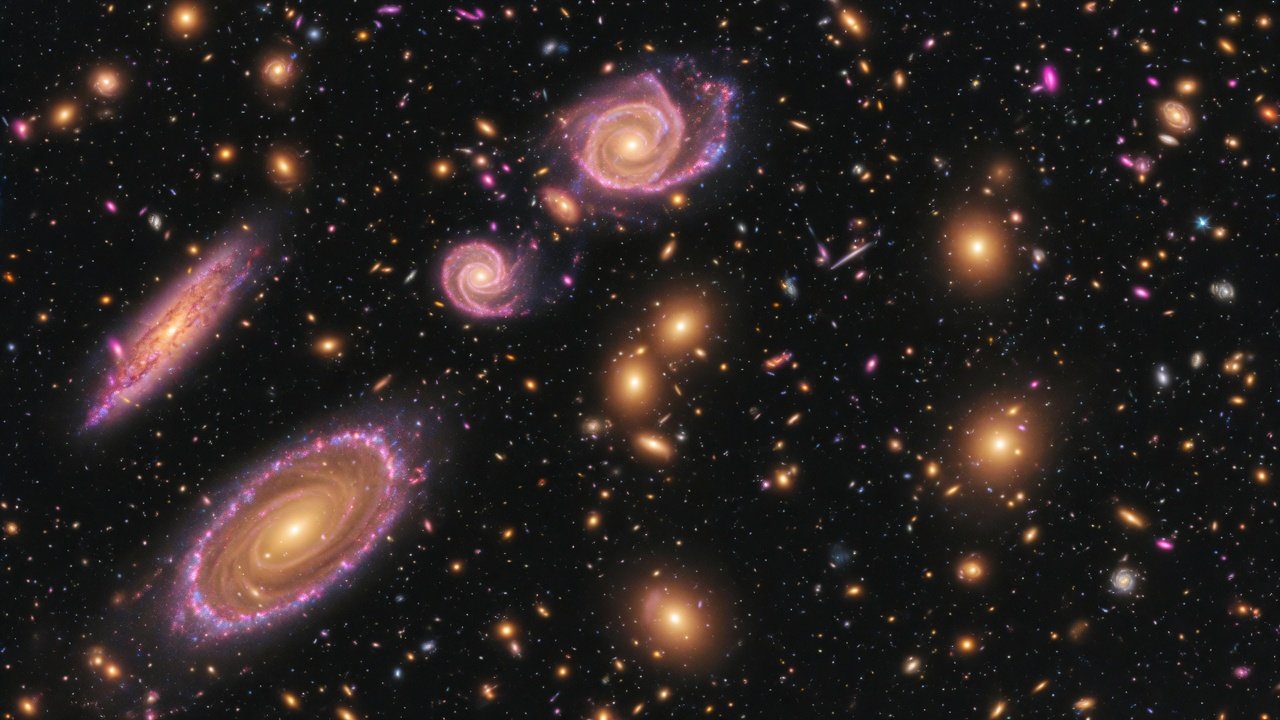
Every photon you've ever seen from another star came from inside one structure: a barred spiral galaxy whose disk spans more than 100,000 light-years and holds somewhere between 100 and 400 billion stars. The uncertainty in that count — a factor of four — is your first calibration point for how partially we know our own home.
The architecture
The Milky Way is a barred spiral: a central bar of older stars feeding a disk threaded with spiral arms, all embedded in a halo of globular clusters and dark matter that outweighs everything visible. At the center sits Sagittarius A*, a supermassive black hole of about 4 million solar masses. We've known it was there for decades from the orbits of stars whipping around an invisible point — work that earned the 2020 Nobel Prize in Physics — but in 2022 the Event Horizon Telescope produced a direct image of its shadow: a ring of hot gas bent around the event horizon, 27,000 light-years away, resolved by a telescope the size of Earth.
Our address within the structure: the Orion Arm (formally the Orion-Cygnus Arm, a minor spur between two major arms), about 27,000 light-years from the galactic center. The Sun orbits that center at roughly 230 km/s, completing one circuit — a galactic year — every 225 to 250 million years. The last time we were here, the dinosaurs were just getting started.
How little of it we've mapped
ESA's Gaia mission has measured precise positions and motions for nearly two billion stars — a staggering dataset, and still around 1% of the stellar population. Saying "we've mapped maybe a few percent of the galaxy in detail" is generous. We can't see large regions of the far side at all; the dust and stars of the disk itself block the view, and the galactic center is opaque to visible light. Much of what we know about our galaxy's spiral structure is inferred — partly by analogy with other galaxies we can see face-on. We live inside the one galaxy we can never photograph from outside.
And the map keeps moving: Gaia data revealed that the disk still rings with waves from past encounters with dwarf galaxies. The Milky Way is not a finished object. It's a system mid-process, currently digesting the Sagittarius dwarf galaxy and on approach to a larger merger billions of years out.
Why it matters to a builder
The Milky Way is the ultimate exercise in reasoning about a system from inside it — incomplete observability, occluded regions, structure inferred from analogues. That's every large production system you'll ever debug. It also sets honest scale for ambition: a civilization that has sent its farthest probe about 0.002 light-years should hold its galactic claims loosely, and its curiosity tightly.