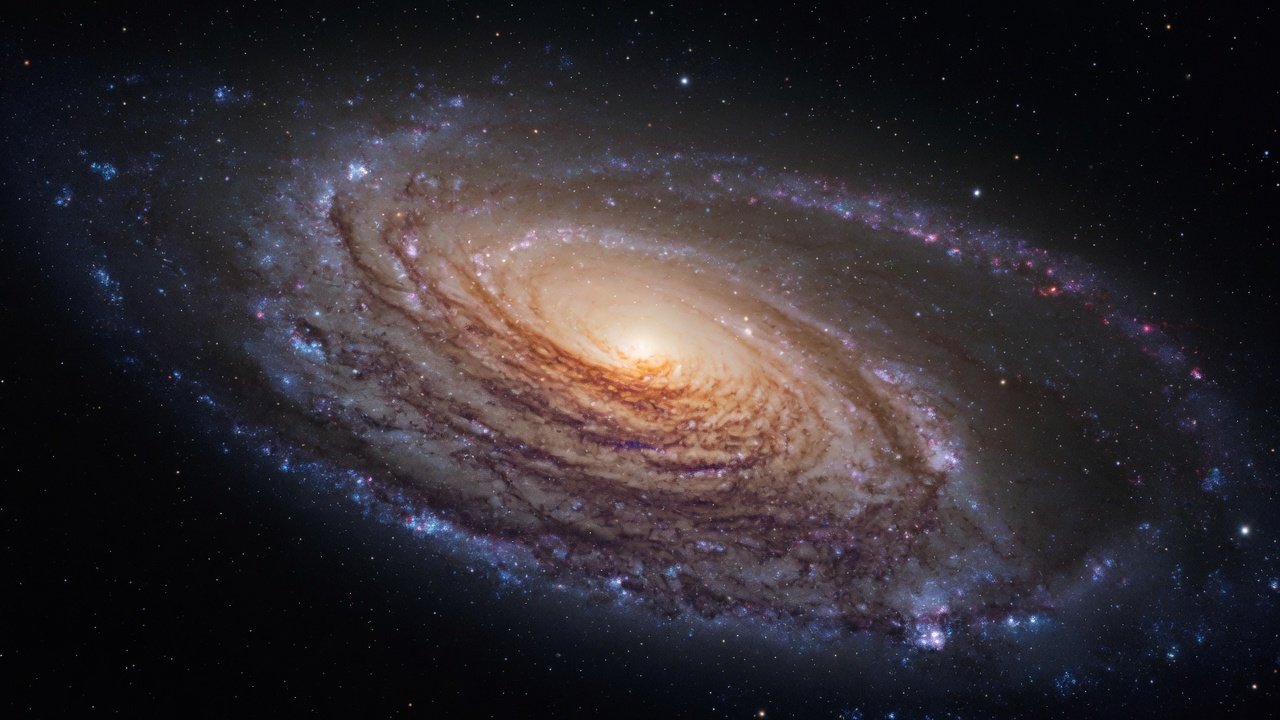
On a dark night, away from city light, you can see a faint smudge in the constellation Andromeda with no instrument at all. That smudge is M31 — a spiral galaxy of roughly a trillion stars, 2.5 million light-years away. It is the most distant object most humans will ever see unaided, and the photons landing on your retina left it before the genus Homo existed.
The nearest large spiral
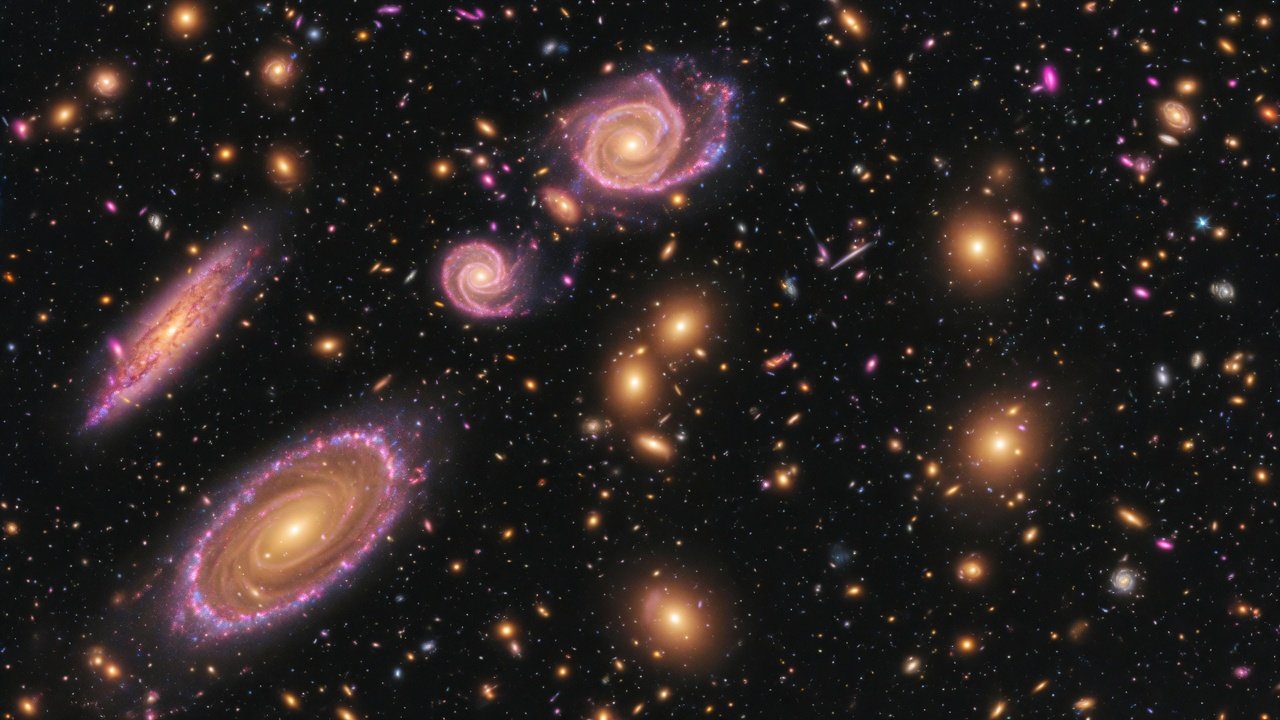
Andromeda is the closest large galaxy to our own and the biggest member of the Local Group, the gravitationally bound cluster of about 80 galaxies that includes the Milky Way, the Triangulum galaxy, and a swarm of dwarfs. Its disk spans well over 150,000 light-years, and while it likely holds more stars than the Milky Way (~1 trillion versus our 100–400 billion), current measurements suggest the two galaxies are surprisingly comparable in total mass once dark matter halos are counted. Andromeda has history written into it: streams of stars from shredded satellite galaxies arc through its halo, the forensic record of past mergers. Galaxies grow by eating.
It also carries a distinction in the history of knowledge: until the 1920s, astronomers debated whether "spiral nebulae" like M31 were small clouds inside the Milky Way or entire galaxies beyond it. Edwin Hubble's identification of Cepheid variable stars in Andromeda settled it — and the known universe expanded by orders of magnitude in a single measurement.
The collision that became a coin flip
For years the standard line was confident: Andromeda is approaching us at about 110 km/s, and in roughly 4.5 billion years the two galaxies will merge into a single elliptical — "Milkomeda." The radial velocity is solid. The complication is sideways motion, which is brutally hard to measure at 2.5 million light-years. In 2025, analyses built on Gaia and Hubble proper-motion data, accounting for the gravitational influence of M33 and the Large Magellanic Cloud, found the merger is closer to a coin flip within the next 10 billion years than a certainty. The honest status: probable eventual interaction, uncertain schedule, headline retired. Either way, no drama for stars themselves — galaxies are mostly empty space, and stellar collisions during a merger would be vanishingly rare.
Why it matters to a builder
Andromeda is a masterclass in error bars: one well-measured velocity component produced decades of confident forecasts that two harder-to-measure components later softened into probability. Builders make the same mistake when they extrapolate a trend from the dimension that's easy to instrument. And the naked-eye fact is worth keeping: a 2.5-million-year-old signal, received with zero equipment, is the cheapest possible reminder of what scale your roadmap actually lives in.